
The Room of Contemplation at the National Museum of Korea

Among the most popular treasures in the National Museum of Korea, these two Pensive Bodhisattvas are probably the greatest highlights. They are more than 1,400 years old, and both are National Treasures. They are also the only objects in the museum displayed in their own independent gallery, called the Room of Quiet Contemplation . The room was designed by Korean architect Choi Wook. You first walk from a bright corridor into a dark passage. While your eyes adjust to the darkness, your mind also begins to calm down. Then you turn right and enter a large hall, but there are only two statues inside. Because there is so much empty space around them, you naturally focus on the statues.  The floor rises slightly toward them, at an angle of about one degree. You may not notice it with your eyes, but your body can sense it, so you naturally walk more slowly. Above you are approximately 21,000 aluminium rods. Their different lengths and angles make the ceiling appear tilted and endless, al...

제갈공명 출사표 내용은?


출사표 뜻:  나갈 출+군대 사

(군대를 이끌고 나갈 때 임금에게 올리는 글)
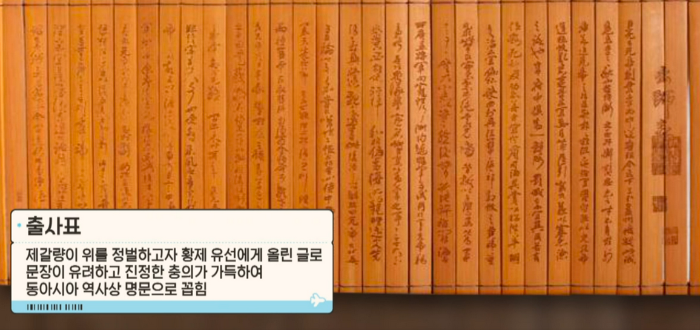

제갈공명은 유비, 유선까지 대를 이어 충성하는 마음을 담아 쓴 것이 출사표의 내용이다.
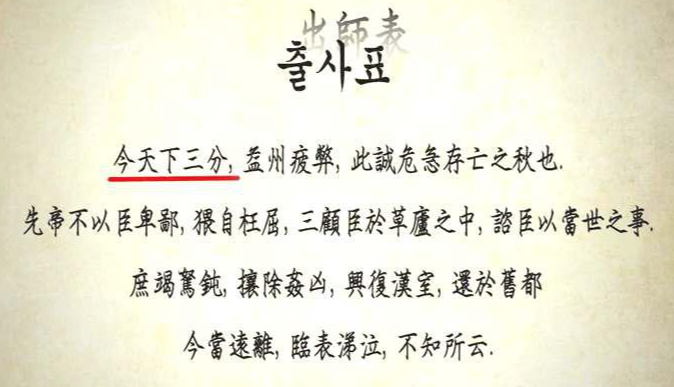


지금 천하가 셋으로 나뉘어 있지만 익주는 피폐하니 이는 진실로 위급하여 존망이 걸린 때 입니다. 선제께서는 신을 비천하다고 생각지 않으시고 외람하게도 스스로 몸을 낮춘 후 삼고초려하여 당시 세상일을 신에게 물었습니다.  바라는 바는 우둔한 재능을 다하여 간사하고 흉악한 자들을 물리치고 한나라 황실을 부흥 시켜 옛 도읍지로 돌아가는 것입니다. 이제 멀리 떠나는 마당에 글을 올리려 하니 눈물이 앞을 가려 무슨 말을 더 해야 할지 모르겠습니다.

Popular posts from this blog

Simudo : The Ten Ox-Herding Pictures

 It tells a powerful story—the story of a boy, an ox, and a journey to enlightenment. Let me tell you the story of "The Ten Ox-Herding Pictures" , or as it's called in Korean, "Simudo" (심우도, 尋牛圖) . 🧒 "Who lost the ox?" This painting is about a boy who lost his ox. But guess what? The ox is not a real ox! It’s a symbol of your true self or your peaceful mind .   And the boy is you, me, all of us—searching for peace and meaning in life. This story is told in 10 simple steps. 1. Looking for the ox The boy feels lost or unhappy. So, he starts looking for something—he doesn't know what yet. 👉 Just like when we feel something is missing in our life and we begin to search for answers. 2. Finding footprints He doesn’t see the ox yet, but he sees its tracks! 👉 Maybe he reads a book or meets a wise person. He’s on the right path! 3. Seeing the ox He sees the ox’s tail! 👉 This is the moment when you start to realize something about yourself—maybe dur...

Master List of Korean Seafood — Explained Simply

Ever walked past a seafood section and thought, "What is all this?" If you've been to a Korean market or restaurant, chances are you've come across unfamiliar seafood names like gajami , gaebul , or seop . Don't worry — in this post, you'll get a complete and simple breakdown of Korean seafood names, their English translations, and how they’re commonly used. Whether you’re a curious foodie or just want to know what you’re ordering, this guide is for you. 🐟 Fish (생선류) Korean Name English Name Description 가자미 (Gajami) Flounder Flat, delicate flesh, great grilled or in stews 넙치 (Neobchi) Halibut Large flatfish, firm white meat 광어 (Gwang-eo) Olive Flounder Most common sashimi fish in Korea 고등어 (Godeungeo) Mackerel Oily and rich flavor, usually grilled 갈치 (Galchi) Hairtail Long and shiny, often braised 연어 (Yeoneo) Salmon Fatty and bold, eaten raw or grilled 참치 (Chamchi) Tuna Served raw or cooked, versatile 명태 (Myeongtae) Alaska Pollock Used fresh, dried, or ferm...

What bear lives in Korea? 한국에 여전히 곰이 살고 있나?

The Asiatic black bear is the only bear that naturally occurs on the Korean Peninsula. It is a medium‑sized black bear with a distinctive white or cream “V”/crescent patch on its chest, which is why Koreans call it “half‑moon bear” (반달가슴곰). In Korea it is classified as an endangered wild animal (Class I) and is also a Natural Monument (No. 329). How many bears are in the wild now? By the late 1900s, hunting and habitat loss had reduced the wild population to only about 5 bears in South Korea. A government re‑introduction program began in 2004, releasing Russian Far East bears that share the same genetic lineage. By 2024, the Korea National Park Service reported about 86 wild Asiatic black bears living mainly in Jirisan National Park. In addition, there are still hundreds of captive bears (around 322 bears on 20 farms as reported recently) used historically for bear farming. Where do they live? Today, almost all wild bears in South Korea are concentrated in Jirisan National Park and nea...