
Why are there so many homeless people around Seoul Station?

 You may notice quite a few homeless people around Seoul Station. A lot of visitors ask me, “Why are there so many homeless people here?” One of the biggest reasons goes back to 1997, during the Asian Financial Crisis. In Korea, we usually call it the IMF Crisis . A lot of companies went bankrupt, unemployment rose very quickly, and many people suddenly lost their jobs and income. Some people eventually lost their homes as well. And many of them came to Seoul Station . Why here? Because this was one of the main places to find day labor and temporary jobs , and it was also the main railway station if they wanted to go back to their hometowns. But some had no money left and nowhere else to go, so they stayed around the station. That is one reason Seoul Station became one of the main gathering places for homeless people after the 1997 crisis. Then another thing happened. Once many homeless people were here, churches, charities, NGOs, and the government started providing help here. Th...

North Korea election system.

Is there an election in Korea? 

Yes, North Korea also has elections. In North Korea,  Voting is mandatory for anyone above the age of 17 or over regardless of their gender or occupation. The turnout of the North Korean election is always almost 99.9% and votes were 100% in favor of the ruling party.  


North Korea ballot. 

Why is turnout 100%? 

Here's a funny thing. Each voter has been given a ballot paper with a single name on it which they then place in a ballot box located out in the open. No marking no choice in candidates. Voters cast their ballots publicly and election wins are always landslides. 

While there are private voting booths, few people use them crossing out a candidate's name. Anybody who crossed out a candidate's name and abstaining are both considered acts of treason. 


Who will North Koreans vote for? 

The election for deputies to the supreme people's Assembly and provincial governors, mayors, and other local officials is held every four years and is closely overseen by the ruling Worker's Party. 

The election for the Supreme Leader of the Supreme People's Assembly is held every five years but the supreme leader, who has been hereditary for three generations, is not elected by the residents but rather chosen by the members of the supreme people's Assembly showing the ballot in front of all people. 
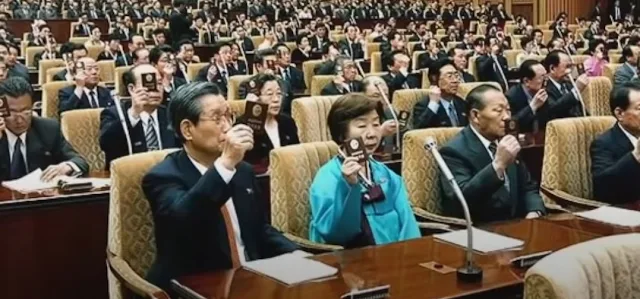


That's the only positive I can think of is that it's a lot less stressful than normal elections because they don't have to worry that they voted for the wrong person. so people enjoy this election day that it's more like a party. 


What's unusual about North Korea's election? 

There is a dress code worn on election day. People have to wear suits. Men should wear formal attire and women must wear hanbok which is Korean traditional clothing. However, many North Koreans do not have hanbok or suits so they often borrow clothes from their neighbors. 

Since they are a single candidate, there's no campaign so residents have no information about the candidate. 


**Deputies to the supreme people's Assembly: 최고 위원회 대의원 

**최고 지도자 김정은 (Supreme Leader) 


Popular posts from this blog

How Cotton Came to Korea and Changed Korean Life (Mun Ik-jeom story)

문익점 목화씨 이야기  Before Cotton: Clothes Were a Winter Problem Before cotton became common, ordinary Koreans mainly depended on hemp cloth . Silk was available, but it was expensive and mostly used by the upper class. Hemp was strong, but it was rough and did not keep people very warm. That was a serious problem during Korea's cold winters. This meant that many poor people suffered severely in winter, and in extreme cases some even died from the cold. After cotton was introduced, this situation changed dramatically. There is also an interesting story about how cotton first arrived in Korea. 1363–1364: The Seeds Came from Yuan China In 1363 , near the end of the Goryeo Dynasty, a Korean diplomatic mission went to the Yuan Dynasty , the Mongol-ruled dynasty in China. One official on that mission, Mun Ik-jeom , returned to Korea in 1364 with about ten cotton seeds. According to a well-known story, he hid the seeds inside a writing brush case (this is the famous anecdote), but it is import...

Old sailing ship in Korea (황포돛배: Hwang po sailing boat)

  Yellow sail boat (황포 돛배  Hwang-po sailing boat )  When you watch Korean historical dramas , you can often see these ships as a means of transportation when people see off someone who is leaving for a long distance, or in a scene where a man and a woman saying farewell leave each other.    Hwangpo means yellow cloth, and it is a sail dyed with red clay water.  The material of the boat is made of pine tree.  It was also a representative symbol of the history of the Han River.  During the Joseon Dynasty, Ships were used to transport regional specialties such as food, firewood, rice and salt to pay taxes along with people.  The characteristic of the boat is flat-bottomed ship. At the time, Koreans traveled on the southern and western seas where the tidal changes are so severe that the mudflats were exposed during low tide.  These flat-bottomed boats were much safer as they were less likely to capsize.  In addition, it played an import...

Doljanchi : the baby’s first birthday (Doljabi)

  Have you ever been to a baby’s first birthday party in Korea? If not, you’re in for a treat. Korean first birthdays are not your typical “cake and candles” kind of thing. It's a big, meaningful celebration with deep historical roots. Let me tell you why it’s so special. Baek-il (백일) So, in the past — especially before modern medicine — infant mortality was really high. Babies often didn’t survive the first few months. That’s why when a baby made it to 100 days old, called "Baek-il" in Korean, it was already considered a miracle. Families would throw a small party to celebrate, inviting relatives, neighbors, and pretty much anyone who wanted to come. It was kind of like saying, “Hey! Our baby made it this far — let’s celebrate life!” But the even  bigger  celebration came at the baby’s  first birthday , which we call  "Dol"  or  "Doljanchi."  By that point, if the baby had reached one year, the family felt hopeful that the child would live a lo...