The Beauty of Emptiness, The Beauty of Blank Space

The Beauty of Empty Space: Why Korean Artists Chose to Leave Things Unfinished Why didn't Korean artists fill the empty space? When you see a Korean painting, a moon jar, or a traditional garden, you may think something is missing. But in Korea, what is left empty is often more important than what is filled. The beauty of empty space isn't simply minimalism. It reflects a historical experience. After political violence forced many scholars to withdraw from public life, they came to value restraint over display. That philosophy eventually appeared as blank paper in paintings, an imperfect seam on a moon jar, and open space in Korean gardens.  Because they believed empty space allows imagination, nature, and the viewer to complete the artwork. Sometimes what is left unsaid carries more meaning than what is fully explained. ------------------------------------------ The Political Root — Why Scholars Started Valuing "Leaving Things Out" Joseon Dynasty Korea (1392–1897) ra...

Seoul World Cup Stadium


World Cup Stadium


World Cup Stadium in Seoul.

 Location : 240, World Cup-ro, Mapo-gu, Seoul, South Korea. 

The Seoul World Cup Stadium was constructed in 2001 for 2002 FIFA World Cup and is the largest stadium in Asia. The stadium hosted the opening match between France and Senegal (0:1) and match between Germany and South Korea(1:0) which is the semi-finals Korea made for the first time. During the semifinals, Korea's cheering squid the Red Devil played the card section that said dreams come true but South Korea lost the game against Germany. The stadium is currently used as the home base for FC Seoul. 


About the Stadium Design 

The exterior of the stadium has a special shape. It was designed like Bangpae Kite(=shaped like shield) and the cable structure is shaped like the sail of a Hwang po sailboat which was a means of transportation in Joseon Dynasty. It was designed with many traditional aesthetics and the shape of the roof attracts attention from afar. 


How to go 

It takes you directly to the World Cup Stadium Station on Seoul Subway Line 6. 


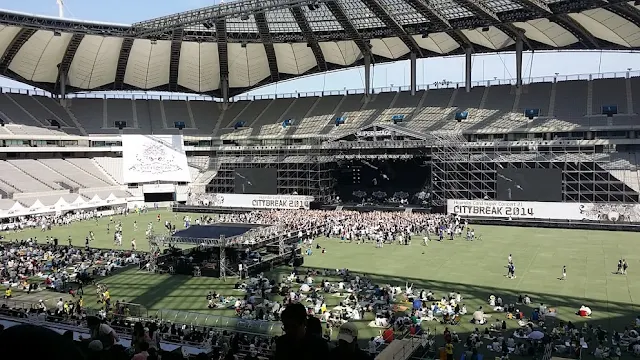
Photo: Music Festival 2014 Super Concert Rehearsal. 

It is the largest stadium in Asia with a capacity of up to 66704 people, the color of seats in the stadium is all grey, so when there are no games or fewer spectators during the concert or events, the large stadium feels desolate. 


 In the stadium, there are various convenience facilities such as Spa&Sauna, wedding hall and food court and mega shopping mall (Homeplus). Moreover there are five World Cup Park near the stadium where people take a rest or enjoy the leisure time and Mapo Agro-fishery product market where you can buy fresh vegetables and fish with cheap price. Due to the these kinds of big markets, people are crowded all year around near here. 

Popular posts from this blog

What bear lives in Korea? 한국에 여전히 곰이 살고 있나?

The Asiatic black bear is the only bear that naturally occurs on the Korean Peninsula. It is a medium‑sized black bear with a distinctive white or cream “V”/crescent patch on its chest, which is why Koreans call it “half‑moon bear” (반달가슴곰). In Korea it is classified as an endangered wild animal (Class I) and is also a Natural Monument (No. 329). How many bears are in the wild now? By the late 1900s, hunting and habitat loss had reduced the wild population to only about 5 bears in South Korea. A government re‑introduction program began in 2004, releasing Russian Far East bears that share the same genetic lineage. By 2024, the Korea National Park Service reported about 86 wild Asiatic black bears living mainly in Jirisan National Park. In addition, there are still hundreds of captive bears (around 322 bears on 20 farms as reported recently) used historically for bear farming. Where do they live? Today, almost all wild bears in South Korea are concentrated in Jirisan National Park and nea...

Buddhist 49-Day Memorial Rites (49재)

 In Buddhism, 49-Jae (사십구재) is the most significant funeral ritual, performed exactly 49 days after a person passes away. The fundamental belief is based on the concept of reincarnation. After death, the soul does not immediately transition to the next life. Instead, it enters an intermediate spiritual state called Bardo (중유/간극) for 49 days.  During this period, the deceased undergoes judgment every seven days by the kings of the underworld, who evaluate the karma—the accumulated deeds—of their past life to determine their next rebirth.   Live carefully. Your actions matter. What you do in this life affects what comes next. This is very Buddhist. Buddhism teaches that life is shaped by karma . Karma means actions and their consequences. Good actions create good results. Harmful actions create suffering. So 49-jae reminds people that death is connected to life, and the afterlife is connected to how we live now. 불교에서 49재 는 고인이 세상을 떠난 지 정확히 49일째 되는 날에 치르는 가장 중요한 ...

Doljanchi : the baby’s first birthday (Doljabi)

  Have you ever been to a baby’s first birthday party in Korea? If not, you’re in for a treat. Korean first birthdays are not your typical “cake and candles” kind of thing. It's a big, meaningful celebration with deep historical roots. Let me tell you why it’s so special. Baek-il (백일) So, in the past — especially before modern medicine — infant mortality was really high. Babies often didn’t survive the first few months. That’s why when a baby made it to 100 days old, called "Baek-il" in Korean, it was already considered a miracle. Families would throw a small party to celebrate, inviting relatives, neighbors, and pretty much anyone who wanted to come. It was kind of like saying, “Hey! Our baby made it this far — let’s celebrate life!” But the even  bigger  celebration came at the baby’s  first birthday , which we call  "Dol"  or  "Doljanchi."  By that point, if the baby had reached one year, the family felt hopeful that the child would live a lo...